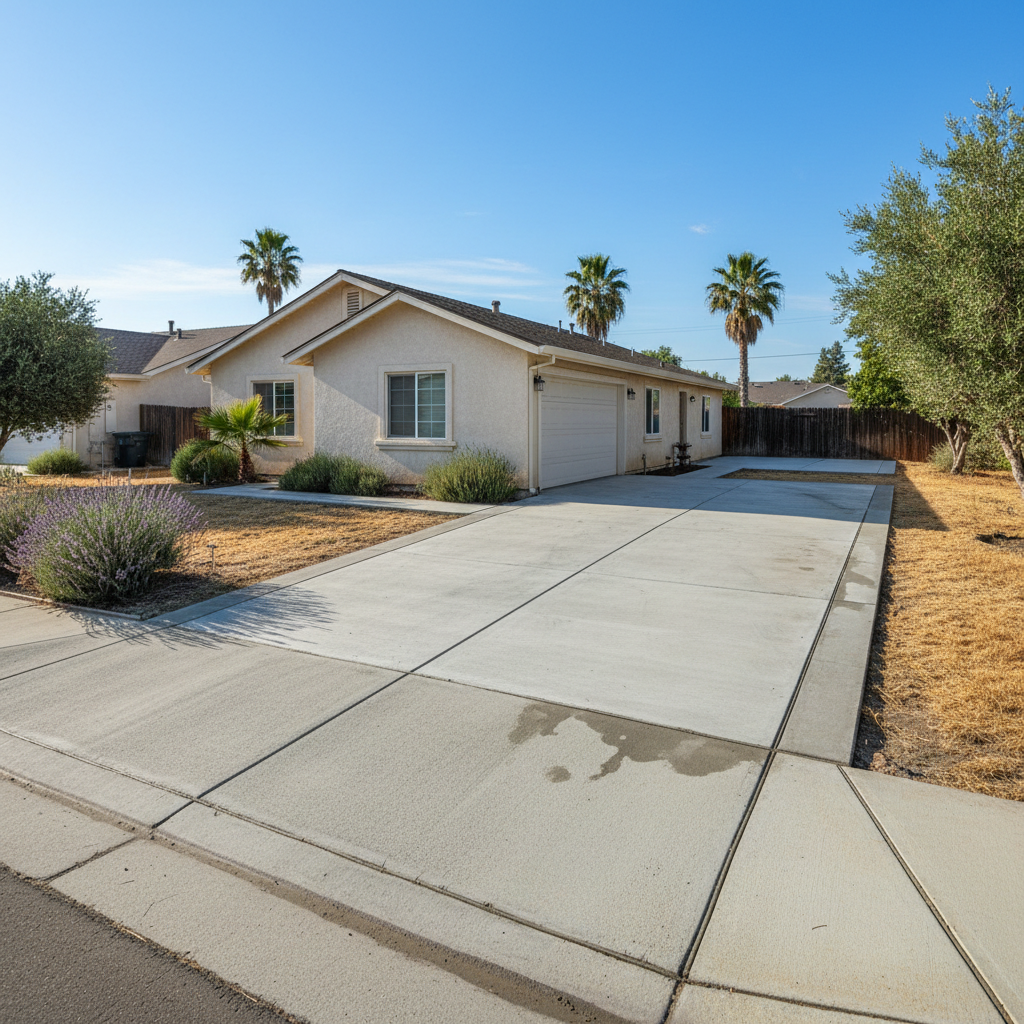
Your concrete's seen better days, huh? Maybe it's a cracked driveway, a sinking patio slab, or those crumbling steps leading up to your front door. It's an eyesore, definitely. But it can also be a tripping hazard or, worse, a sign of bigger problems lurking underneath. So, what's it actually going to cost to fix it?
Look, I get it. Nobody really wants to spend money on repairs, especially when you're not sure if you're getting a fair shake. As a local contractor with Alpha Concrete, I've seen all sorts of concrete issues around Manteca. From the older homes near Woodward Park to the newer developments out by River Islands, we've handled them all. Here's the straight talk on what affects concrete repair pricing, what you can expect to pay, and how you can make sure you're not overpaying.
What Drives Concrete Repair Costs?
It's not just a simple square footage calculation, though that does play a part. Several factors really push the price up or down, and understanding them helps:
- The Type of Damage: A hairline crack, for instance, is way cheaper to fix than a slab that's sunk three inches because of bad soil compaction or water erosion. Spalling (that's when the surface flakes off) is also different from a full-depth structural crack.
- The Size and Depth of the Repair: Naturally, fixing a small, shallow crack in a sidewalk takes less work and material than replacing a big section of a driveway or lifting a substantial patio slab.
- Accessibility: Can we get our equipment right up to the repair area? Or do we have to hand-carry everything through a narrow side yard? If we're working in a tight spot—like a backyard patio with no gate access—that's definitely going to add to the labor cost.
- Material Costs: Concrete, patching compounds, rebar, crack fillers, sealers – these all have different price points. If we're doing mudjacking or slab jacking, the cost of the grout or polyurethane foam also varies.
- Prep Work & Demolition: Sometimes, the old concrete is so bad we need to completely remove it before pouring new concrete. Demolition, hauling away debris, and proper sub-base preparation (like compacting the soil, which is super important in our expansive clay soils here in Manteca) all add to the total.
Typical Repair Cost Ranges in Manteca
I can't give you an exact price without seeing the job, that's just not how it works. But I can give you some realistic ranges based on what we see most often:
- Small Crack Repair (Hairline to 1/4 inch wide): For minor, non-structural cracks that we can fill and seal, you're usually looking at $150 - $400 for a few linear feet. This often covers a minimum service call charge.
- Medium Crack Repair (Wider, Deeper, or Multiple Cracks): For more extensive crack filling, routing, and sealing over a larger area, or if we need to use epoxy injection for structural integrity, expect something in the range of $400 - $1,200.
- Spalling or Surface Repair: If your concrete surface is flaking or pitted but the slab itself is sound, we can often resurface it. This might cost anywhere from $3 to $7 per square foot, depending on the product and prep needed. A typical 100 sq ft patio, for example, might run $300 - $700.
- Slab Jacking / Mudjacking (Lifting Sunk Slabs): This method is for concrete that has settled unevenly. Instead of replacing it, we inject material underneath to lift it. We usually price this per void or per square foot of lifted area. For a typical driveway section or patio, you might see costs from $600 to $2,500+, depending on the size and how much material we need.
- Partial Slab Replacement: If a section is just too far gone for repair, we'll cut out the bad part, remove it, prepare the base, and pour new concrete. For a 4x4 foot section of a driveway, you could be looking at $500 - $1,000. Larger sections, like a 10x10 foot patio section, might be $1,000 - $2,500, and that includes demolition and hauling.
These are just averages, remember. A small, simple job might hit the lower end, while complex or large-scale repairs will be higher.
What Should a Quote Include?
When you get a quote from Alpha Concrete or any other reputable contractor, it should be clear and detailed. Don't settle for a scribbled number on a napkin, honestly. A good quote will typically break down:
- Scope of Work: Exactly what we're repairing, where, and how. Will it be crack filling, resurfacing, slab jacking, or replacement?
- Materials: What kind of concrete, patching compound, or lifting material will we use?
- Labor: The cost of the crew's time.
- Equipment: Any specialized tools or machinery needed.
- Prep Work: Details about demolition, sub-base preparation, cleaning, etc.
- Cleanup & Hauling: What happens to the old concrete or debris?
- Permits: If required (most minor concrete repairs don't need them in Manteca, but it's good to confirm).
- Warranty: What kind of guarantee do they offer on their work?
How to Avoid Overpaying for Concrete Repair
- Get Multiple Bids: Always, always, always get at least three quotes. This helps you compare not just price, but also the proposed solutions and the contractor's professionalism.
- Understand the Solution: Don't just accept a price. Ask questions! Why are they recommending this particular repair method? What are the pros and cons? A good contractor will explain it clearly.
- Check References & Reviews: See what other people in Manteca are saying about them. Were they on time? Did they stick to the budget? Was the work quality good?
- Don't Go for the Cheapest Bid Automatically: The lowest price often means shortcuts, lower quality materials, or inexperienced labor. Concrete repair isn't something you want to do twice, trust me.
- Get Everything in Writing: This protects both you and the contractor. Make sure the quote matches the final contract.
Concrete repair isn't the most exciting home improvement, but fixing it right the first time saves you headaches and money down the road. If you've got questions or need a solid quote, give us a call. We're here to help.