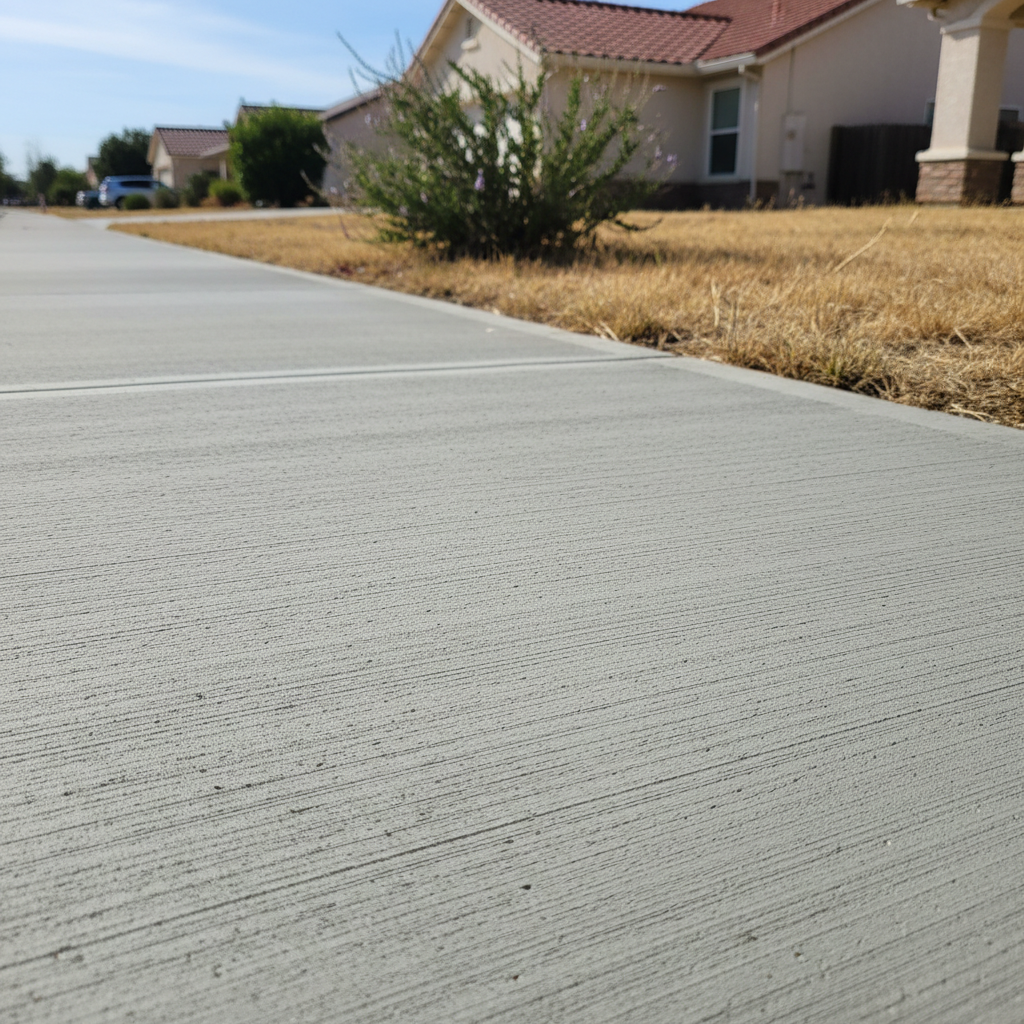
Alright, let's talk about concrete sidewalks. You probably do not think about them much until there is a problem. But here in Manteca, California, with our hot summers and sometimes shifting soils, those sidewalks can take a beating. As Alpha Concrete, we have poured and repaired enough of them to know what homeowners are really wondering. So, we will give you the straight facts on the most common questions we get about Concrete Sidewalks in Manteca.
Who is Responsible for Sidewalk Repair in Manteca?
This is probably the number one question, and it is an important one. Here is the deal: in California, state law (Streets and Highways Code 5610) says that property owners are generally responsible for maintaining the Concrete Sidewalks in front of their property. This means keeping them in a safe condition so they do not endanger people or interfere with public convenience in Manteca.
Now, the City of Manteca does have a Streets Division that handles curb, gutter, and Sidewalk Repairs, among other things. But do not let that fool you. While the city might step in for certain issues, like damage caused by city trees or workers, the primary responsibility for Concrete Sidewalk maintenance and liability often falls back on you, the property owner in Manteca. If someone trips over an uplifted Concrete Sidewalk in front of your place, you could be on the hook, especially if the city has an ordinance that places liability on the owner. The City of Manteca can even charge you for Concrete Sidewalk Repairs if you do not take care of it.
Do I Need a Permit to Repair or Replace My Sidewalk in Manteca?
Yes, you absolutely do need a permit for Concrete Sidewalk Repair or Concrete Sidewalk Replacement in Manteca. Any work within the street right-of-way, which includes your Concrete Sidewalk, typically requires an Encroachment Permit from the Public Works Department. You cannot just start tearing things up or pouring new Concrete Sidewalks without getting the proper approvals in Manteca. The City of Manteca uses an online Citizen Access portal for permits, so you can apply and check on things there. Make sure you have your plans and documents on-site for any inspections of your Concrete Sidewalk project.
How Long Should a Concrete Sidewalk Last in Manteca?
A well-installed Concrete Sidewalk can last a good long time, usually between 25 and 40 years. Some Concrete Sidewalks can even go 50 years or more if they are very well-maintained in Manteca. But that is not a guarantee. Things like the quality of the concrete mix, how well the ground was prepared underneath the Concrete Sidewalk, proper thickness of the Concrete Sidewalk, and good drainage all play a huge role in the lifespan of a Concrete Sidewalk in Manteca. If a Concrete Sidewalk is poorly installed or takes a lot of abuse, you might see cracking and settling in as little as 10 to 15 years.
What Causes Sidewalks to Crack and Lift in Manteca?
There are a few main culprits we see all the time with Concrete Sidewalks in Manteca. First, you have the natural expansion and contraction of concrete due to temperature changes. Concrete expands when it is hot and shrinks when it is cold. Without proper joints in the Concrete Sidewalk, this stress can cause random cracks in the Concrete Sidewalk.
Then there is our local soil in Manteca. Manteca has its share of expansive clay soils, and when those soils get wet and dry out, they can shift and move, pushing up or pulling down on your Concrete Sidewalk. Tree roots are another huge factor, especially with older, larger trees in Manteca. They grow under the Concrete Sidewalk, lifting sections and creating tripping hazards. Poor subgrade preparation before the Concrete Sidewalk was poured can also lead to settling and cracking of the Concrete Sidewalk.
What is the Deal with Those Lines in the Sidewalk? (Expansion and Control Joints for Concrete Sidewalks)
Those lines in your Concrete Sidewalk are not just for looks; they are important for the longevity of your Concrete Sidewalk. There are two main types of joints for Concrete Sidewalks: Expansion Joints and Control Joints.
- Expansion Joints: These are usually wider gaps filled with a flexible material like cork or plastic. You will often see Expansion Joints where a Concrete Sidewalk meets a building, a driveway, or another existing concrete slab. Expansion Joints act like a shock absorber, allowing the Concrete Sidewalk to expand and contract freely without pushing against other structures and causing damage to the Concrete Sidewalk.
- Control Joints: These are the shallower lines you see regularly spaced across the Concrete Sidewalk. Concrete is going to crack; it is just a fact of life. Control Joints are essentially